


Cyclic Simple Shear Testing for evaluation of liquefaction potential
Liquefaction is a condition in which pore water pressures within a soil mass increase significantly under cyclic loading, pushing soil particles apart and drastically reducing shear strength and the ability to withstand applied stresses. Cyclic Direct Simple Shear (DSS) testing is one of the most widely used laboratory methods for evaluating the cyclic response of soils and their susceptibility to liquefaction.
In these tests, soil specimens are enclosed within a stack of non-deformable rings and axially constrained between two parallel rigid platens: the top cap and the base pedestal. After the specimen is loaded axially to a specified stress level and allowed to consolidate, it is sheared laterally by displacing one platen relative to the other, as shown in Figure 1.
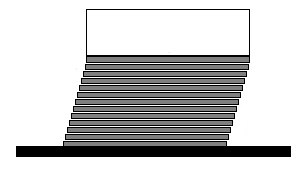
Figure 1– Direct Simple Shear loading
Because liquefaction is fundamentally associated with excess pore water pressure generation under undrained loading, the reliability of cyclic DSS test results depends critically on how well undrained conditions are reproduced in the laboratory. In DSS testing, these conditions are typically achieved by enforcing constant volume rather than directly measuring pore water pressure, as is done in triaxial testing. The underlying assumption is straightforward: if the specimen is prevented from changing volume, any tendency to contract or dilate during shearing must manifest internally as changes in pore water pressure.
Since the specimen area remains constant during testing due to the stack of rings, its volume is controlled by its height. Even very small changes in height can introduce partial drainage and allow excess pore pressure dissipation. This is undesirable, as it can lead to an overestimation of the soil’s resistance to liquefaction, requiring more loading cycles to reach failure.
This has led to the need for DSS machines capable of restricting specimen height changes during cyclic loading. In this way, true constant-volume conditions can be achieved and the soil’s actual resistance accurately determined. There are two approaches to maintaining specimen height during shear loading: passive-height control and active-height control. This article discusses both approaches and highlights the importance of active-height control for ensuring the integrity of test results..
Passive-Height Control
In many DSS devices, specimen height is controlled passively by a stiff vertical loading frame or reaction system. The concept is simple: the apparatus is assumed to be sufficiently stiff that vertical movements are negligible when the specimen attempts to contract or dilate.
In reality, no mechanical system has infinite stiffness. Several components contribute to overall compliance, including:
- The vertical loading column and its connections
- Bearings and joints
- Load cell compressibility
- Hydraulic or electromechanical actuators
- Frame deformation
Even if each component is individually stiff, their combined compliance can be significant relative to the very small displacements required to induce volume change in soil specimens. In addition, system stiffness may vary with load level, degrade over time due to wear or temperature effects, or differ between machines that are nominally identical. Therefore, truly constant-volume conditions are practically impossible to guarantee using this approach.
Active-Height Control
Active-height control directly addresses the limitations of the passive approach by continuously monitoring specimen height and correcting any deviation from the target value in real time using a closed-loop control system. Height changes are measured as close to the specimen as possible using high-accuracy, compact displacement transducers (LVDTs) mounted directly on the platens. If the specimen attempts to contract or dilate during cyclic shearing, the control system immediately counteracts this movement.
The advantages of this type of control are:
- True constant-volume conditions are enforced
- Results are independent of frame stiffness
- Variability between machines is reduced
- Repeatability and reproducibility are improved
Implementing active-height control requires:
- High-resolution vertical displacement measurement
- High-accuracy displacement sensors
- Optimal sensor placement to minimize the influence of machine deflection
- A responsive actuator capable of fine adjustments
- Well-tuned control algorithms
Although this approach adds complexity and cost, the improvement in data quality and reliability is substantial. For laboratories engaged in liquefaction research or high-quality site characterization, active-height control should be considered essential rather than optional.
How VJ Tech addresses these limitations
VJ Tech, a leader in soil testing equipment, has addressed the limitations of cyclic DSS testing through the design of a new DSS system. Stainless steel side plates, a rigid base plate, and a reinforced central load path minimize deflection under load, while extended linear guidance rails provide stable, low-friction shear movement during both static and cyclic testing. Figure 2 illustrates the expected frame deflection under cyclic shear loading conditions. By minimizing system deflection, the active-height control can operate more effectively, eliminating deviations from truly undrained conditions. A reinforced load path and external linear bearing guidance reduce structural deflection and rotational effects during shearing, thereby improving system stability and repeatability in both static and cyclic tests.
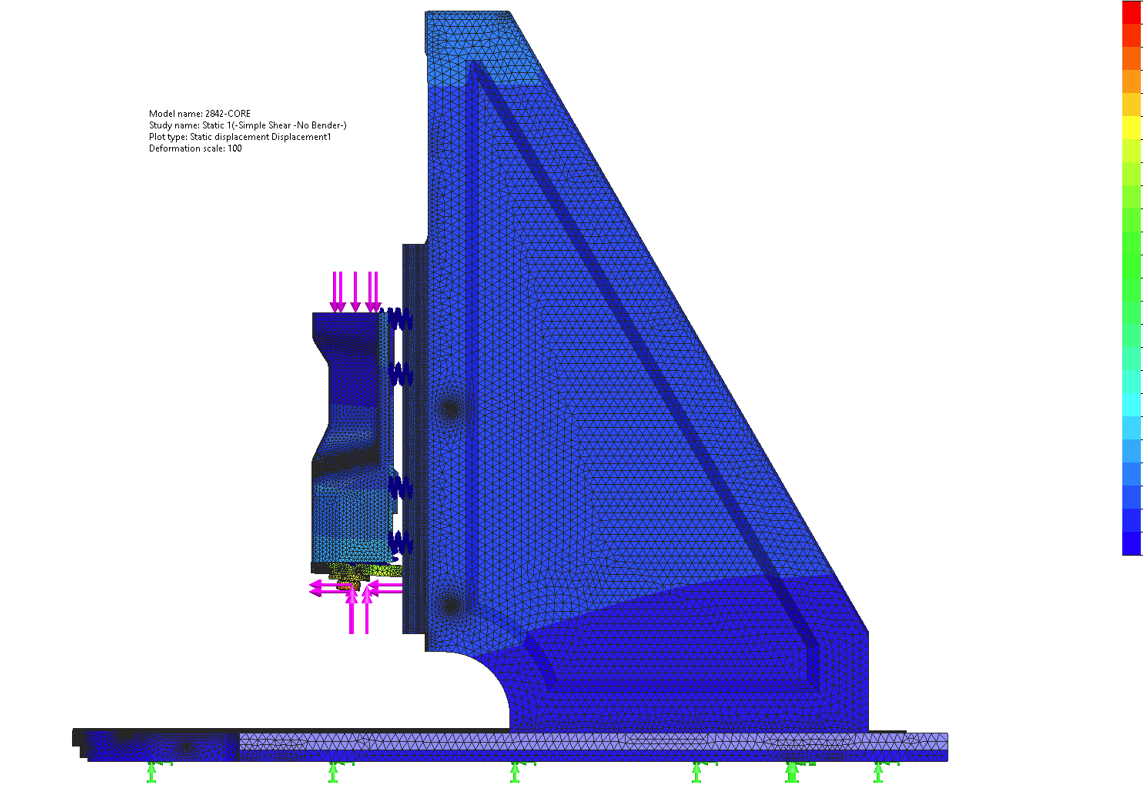
Figure 2
The active-height control in the VJ Tech Cyclic DSS system is achieved through a set of LVDTs mounted directly on the top cap and base pedestal. Any small change in specimen height caused by dilation or contraction is immediately detected by the sensors. Fast data acquisition (500 Hz) and a closed-loop control frequency of 10 kHz enable rapid detection and system response. The electromechanical actuators incorporated into the system provide fine control, ensuring that even minor deviations from constant-volume conditions are corrected with high precision.